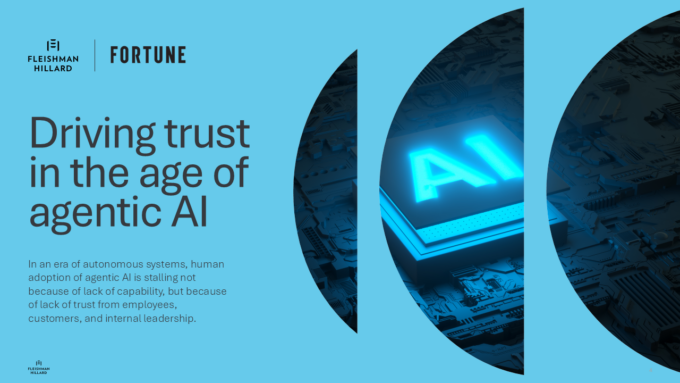
In an era of autonomous systems, human adoption of agentic AI is stalling not because of lack of capability, but because of lack of trust from employees, customers, and internal leadership.
Across business today, there is fundamental tension: workforces are fearful they are “building their own coffins,” anxious that AI will eliminate their roles entirely. Yet this narrative is far from the truth. The businesses that will win in the agentic AI revolution are those that intentionally explain – both inside and outside their organisations – how this technology can fundamentally enhance their capabilities and competitive position. The real challenge for communicators is that adoption is not primarily a technical issue, it is a behavioural and cultural one.
This is where trust becomes critical. Our recent ‘Trust in the Age of Agentic AI’ panel event revealed a striking paradox: hundreds of millions of people use AI because it is useful, yet many remain uncertain about trusting it. The terminology itself is broad and often poorly understood by audiences and employees alike. Adoption, as our panellists highlighted, is constrained not by capability but by behaviour and culture. Yet there is a hidden risk embedded in this adoption curve. AI outputs are so polished and convincing that organisations risk what one of our esteemed panellists Ramaa Sharma, called “cognitive surrender” where teams accept answers without critical thinking, experiencing false confidence in tools simply because they feel authoritative. Bias can be built into these systems and calibration, an accurate understanding of what AI can and cannot do, is often absent. The question organisations face is not whether to adopt, but how to adopt in a way that maintains rigour, accountability, and human judgment at every stage.
For communicators in particular, your role in bridging the gap between organisational capability and organisational confidence is essential. The most successful organisations will be those that communicate deliberately about why they are using agentic AI, not just what they are building. This requires transparency about both the potential and the limitations, clarity on how this technology enhances rather than replaces human expertise, and a commitment to keeping the thinking human. As our panellists concluded, people will always be in charge of AI. Your creativity, expertise, and organisational culture will ultimately determine whether agentic AI becomes a force multiplier for your business or a source of ongoing anxiety and mistrust. This report provides insights, research findings and useful tips to help navigate that complexity.
Explore this topic in full in our latest report: Driving Trust in the Age of Agentic AI
Report researched and written by Claudia Bate, Ephraim Cohen, Ramaa Sharma, Mark Egan, Kamal Ahmed