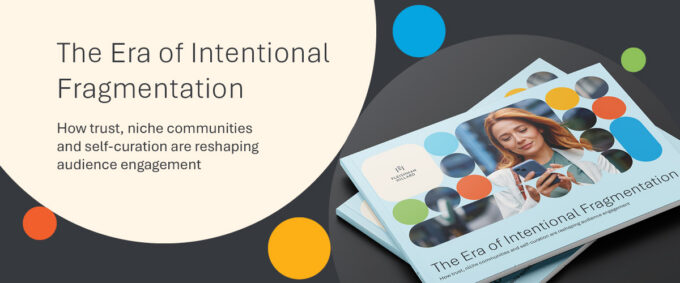
The Era of Intentional Fragmentation, a report by FleishmanHillard UK
At first glance, it looks like chaos.
For years, starling murmurations baffled scientists. Thousands of birds wheeled across the sky, appearing unpredictable to the naked eye. Until closer study revealed something else: that each movement followed simple, deliberate rules. What looks like chaos is, in fact, curated.
Digital audience behaviour today is following a similar pattern. What appears as scattered platform fragmentation is actually audiences deliberately engineering their own information ecosystems as a result of declining trust, platform bloat, AI-generated noise, and information overload.
The topline metrics tell you where attention is moving, with rapid growth in platforms built around niche communities on Substack, Discord, Reddit, etc. But the platform shift is only the symptom of something bigger. The real insight lies in understanding the behavioural shifts behind it.

The five forces of fragmentation
From Gen Z to the boardroom, audiences are actively reshaping how and where they engage. Our research reveals five converging forces driving this shift across even the most distinct professional and demographic groups.
01 – The trust recession: AI-generated content, algorithmic manipulation, unverified sources and declining confidence in traditional media outlets are driving audiences away from what they perceive as ‘untrusted sources’.
02 – Platform bloat is breaking the “everything app” model: Users are unbundling platforms by role, because no one platform can do everything well.
03 – Social gravity now outweighs platform gravity: People follow trusted individuals and communities, not logos. In other words, attention accrues to trusted relationships, not to the biggest or most established channels.
04 – Authenticity sensitivity: As AI content floods the system, audiences are developing more sophisticated filters and relocating to spaces where human curation is visible and verifiable.
05 – Self-curation is the new survival skill: Faced with infinite content, audiences are aggressively narrowing their inputs to protect their time, focus, and mental bandwidth.

Fragmentation may look like a barrier, but in reality, it’s a roadmap drawn by the very people organisations want to reach.
Every shift in platform, every move towards smaller communities, every subtle act of self-curation is a signal of where trust and influence are quietly relocating. Organisations that are able to navigate these signals will find themselves in the ecosystems where influence truly grows, contributing to exchanges that shape decisions and loyalties.
At FleishmanHillard, our UK Digital and True Global Intelligence teams have unpacked behaviours of four distinct audiences – Gen Z, C-suite executives, healthcare professionals, and IT decision-makers – examining why they are fragmenting, and where they are consolidating. We’ve mapped ecosystems and communities where real engagement is happening, giving organisations the insights needed to become trusted nodes within their target audiences’ designed networks.
For more insights, download and read the full report below.
Download The Era of Intentional Fragmentation
For more information and enquiries, please email [email protected]
Report researched and written by Chloe Platts, Chloe Partikas, Cristina Stief, Cloe Roycroft, Nia Roberts, Ben Levine